 Mindfactor.
How to Calm Yourself After a Stressful, Hyped Meeting
When the call ends but your body is still sprinting, here is a gentle way to come back down without pretending you were fine the whole time.
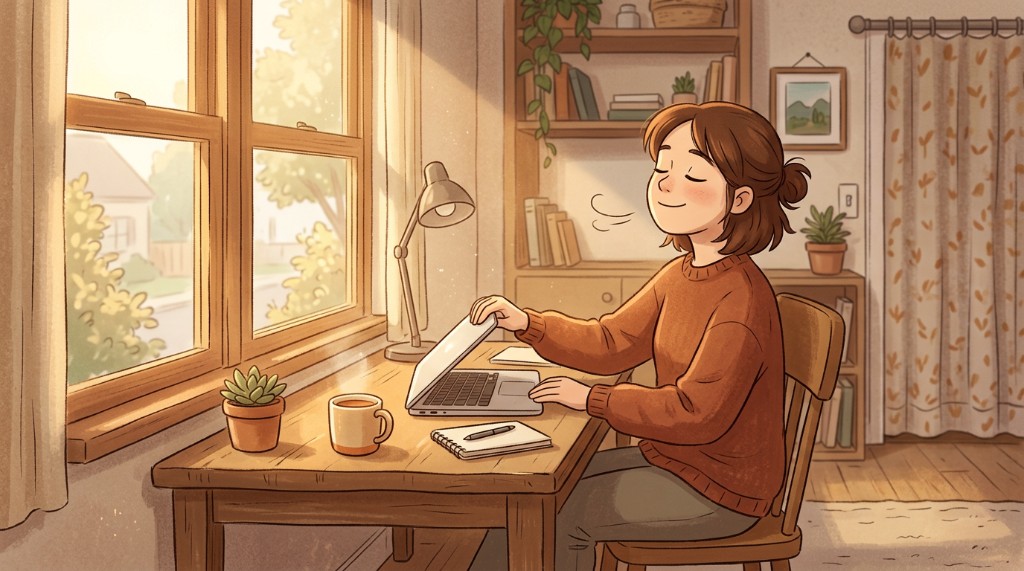
The calendar block turns green. You click Leave. For half a second the room is quiet—and then your shoulders drop half an inch and you realize they had been up near your ears the whole time.
Your heart is still doing that thing. Not a full panic, more like you drank two coffees you did not order. Someone said something sharp. Someone else talked over you. Maybe nothing dramatic happened at all; maybe it was just a lot of noise and decisions packed into one small rectangle on your screen. Either way, you are still wired.
That hyped, buzzy feeling is not a character flaw. It is your nervous system doing what it was built to do: stay alert when the tribe is debating survival. Your body does not know the difference between a budget review and a lion. It only knows we were on.
What is actually happening
When we are in performance mode—explaining, defending, reading the room—sympathetic arousal ramps up: faster pulse, tighter jaw, shallower breath, thoughts that loop. That is not broken. It is load.
The hard part is the moment after. The meeting ends, but the alarm does not get the memo right away. You might replay a sentence you wish you had said differently, or fixate on someone else's tone, or feel suddenly exhausted and irritable at the same time.
You are not failing to "move on." You are still carrying the charge.
The meeting is over. Your body might need a few honest minutes before it believes that.
A small visualization: empty chair, open window
If you can, stay seated for a moment before you rush to the next tab. Close your eyes if that feels safe; if not, let your gaze rest on something boring—a wall, a plant, the edge of your desk.
Picture the meeting as a chair you were sitting in—tight back, bright lights, voices overlapping. Now picture yourself standing up from that chair. You do not have to push the chair away violently. You can simply notice your feet on the floor and let the chair stay where it is, behind you.
Imagine a window in that room opening just an inch—cool air slipping in. Each exhale is that small opening. You are not trying to empty your mind. You are only letting the room get a little bigger than the argument.
Stay with that for three slow breaths. In through the nose, out through the mouth like you are fogging a mirror—soft, not forced.
Things you can do with your actual body (no app required)
1. Name it out loud, quietly.
Even whispering That was a lot to yourself can interrupt the spiral. Shame loves silence.
2. Temperature as a reset.
Splash cool water on your wrists or the back of your neck. Hold a cold drink in both hands for ten seconds. Your nervous system reads temperature change as new information, which can break the loop.
3. Five minutes of ugly paper.
If your mind is replaying the meeting, give it one page of a notebook—messy bullet points, no craft. When the page is full, close the notebook. You are not solving the meeting again; you are handing your brain a place to put the static.
4. Move like you are not being watched.
Shoulder rolls, a slow walk to the kitchen, standing up and sitting down once like you mean it. You are not exercising for virtue. You are reminding your body it has a size beyond the rectangle.
5. Delay the next hit of stimulation.
If you can, wait before opening email or Slack. Not as discipline—as kindness. Your eyes and brain just finished a sprint.
If the buzz will not leave
Sometimes the body stays loud longer than we think it should. That can be uncomfortable, even scary. If you ever feel unsafe with your own thoughts, or like you cannot come down for a long stretch, reach out to someone you trust or a professional—that is strength, not drama.
For the ordinary, awful wired feeling after a hard meeting: you do not have to earn rest by analyzing every word first. You can be a person who had a rough hour and still deserves water, air, and a slower next step.
The room will still be there when you get back. For now, let the window stay open a little longer.
How did this post feel?
Comments
0 totalNo comments yet. Be the first to share a thought.
Thanks for reading.
If this resonated with you, share it with someone who might appreciate it — or keep exploring.